

Multilingual websites and online stores for several countries
A multilingual website needs more than a language switcher and a translation plugin to be found in a second country. We build each language version as a site in its own right, with its own URLs, hreflang and keyword research, and on Shopify we set up VAT per country.
Last updated
What a multilingual website from us includes
We build multilingual websites and Shopify stores in which every language has its own URLs, hreflang tags and keyword research, and on Shopify we set up VAT per country. We work on Webflow, Shopify or custom code, for companies that sell from one country into others and want each market to find them in its own language.
Who a multilingual website is for
This is for brands and online stores that sell in more than one country, or want to. For example, a Dutch online store that starts selling in Germany and Belgium, or a Turkish producer selling across the EU. It works best when you already know which markets matter most, so the first language versions go where the demand is.
What you get with a multilingual website
We choose the countries and languages with you first, then build every version on its own URLs and connect the versions, so Google knows which page belongs to which market. On Shopify, one store then serves several countries, with VAT set up per country.
- Market and language plan
- We decide with you which countries and languages come first, based on search demand in each language and where you already sell.
- Own URLs per language
- Every language version gets its own URLs, so Google can show the right page to the right searcher.
- Hreflang and sitemaps
- We set up hreflang and a sitemap per language, so search engines know which page belongs to which market.
- Keyword research per language
- People in each country search with their own words, so every language gets its own keyword research before pages are built.
- VAT per country
- On Shopify we set up VAT rates per country through the Shopify product category, so every market charges the right rate.
- Several markets, one store
- We set up Shopify Markets so one store can serve several countries, each with its own language version.
- Multilingual SEO
- Titles, FAQs and structured data (schema) per language, so each version can be found in Google and in AI answers.
Multilingual sites and stores we built
One is a client store that used to be in Turkish only, and two are our own brands, where every choice about languages and URLs was ours to make.
Avrupa Yöresel sells Turkish regional products from Amsterdam to the Netherlands, Germany, Belgium and France. For its store we set up VAT per country through the Shopify product category and filled in the SEO fields.
Avrupa Yöresel · Language versions
Before, the store ranked for 0 of 506 keywords in its customers' language, and now Avrupa Yöresel has Dutch and German language versions with their own URLs.
Source: Hault's audit of the Avrupa Yöresel Shopify catalogue.

Private Label Specialist

How we build a multilingual website
We start with an audit of your site and the words customers search with in each market. The blueprint fixes the URL structure, the language versions, the VAT setup and the order in which markets go live. Then we build each version, set up hreflang, sitemaps and redirects, and launch market by market.
- Kick-off and audit
- Blueprint
- Prototype
- Build and launch
- Automate and improveOngoing
A project usually takes 6 to 10 weeks, depending on the number of languages, markets and pages.
What a second language version needs besides translation
Each language version needs its own URLs, hreflang tags that connect it to the other versions, a sitemap and its own keyword research. An online store also needs the right VAT per country, because a wrong rate shows up as a wrong price at checkout.
Many sites add a language switcher and a translation plugin and stop there. The result is often one set of URLs and pages that read as translated, so search engines don't know which version to show, and customers in the second market land on the wrong language or don't find you at all.
Avrupa Yöresel shows why the details matter. The store sells Turkish regional products to customers in the Netherlands, Germany, Belgium and France, and before our work it ranked for 0 of 506 keywords in its customers' language, because everything was in Turkish. We audited its 773 products, filled in the SEO fields, added Dutch and German language versions with their own URLs and brought the menu down from 20 groups to 8. VAT rates are now set up per country through the Shopify product category.
How Google and AI answers find each language version
Google and AI tools can only show a language version they can find and read. We give every version its own URLs, connect them with hreflang, list them in a sitemap per language and add structured data (schema) and FAQs in that language, plus an llms.txt file and a check that AI crawlers can reach the pages.
That is multilingual SEO (search engine optimisation), and its AI side is AEO and GEO, which are about being found and cited in answers from ChatGPT, Perplexity and Google AI Overviews. People in Germany don't type a translation of your Dutch keywords, so each language gets its own keyword research before anyone builds a page.
For Gül Reizen, a Turkish-Dutch travel organisation in Amsterdam, we researched search terms in Dutch and Turkish. We then built a new Dutch version with 10 pages and a blog, an FAQ system and structured data. In one measurement on one day, 12 October 2026, seven search terms without the brand name were in the mobile top 10, up from none, and the brand was named in 6 of 10 AI answers, up from 0 of 8.
Which countries and languages to start with
Start with the countries where you already sell, or where people already search for what you offer, and add the rest later. We look at search demand in each language and where your orders come from today, and we agree the order of the markets in the blueprint.
Each language you add needs its own keyword research and its own pages to keep up to date. Starting with one or two markets keeps that work manageable, as long as the URL structure is planned with room for the next language.
Selling in several countries from one Shopify store
One Shopify store can sell to several countries when it's set up for it. Shopify Markets gives each country its own language version and settings, and VAT rates can be set per country through the Shopify product category. You keep one catalogue and one back office, while customers in each market see a store in their own language.
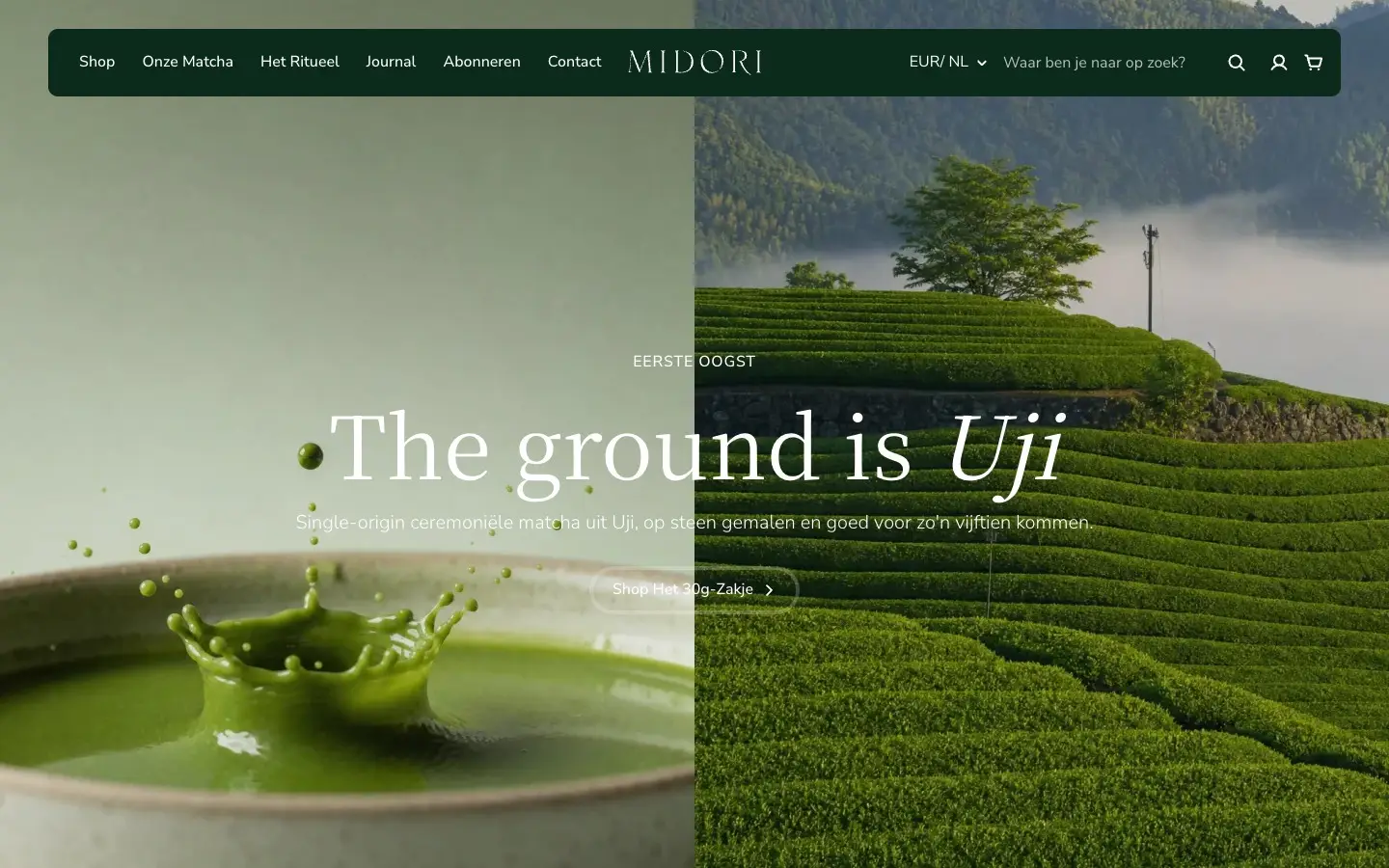
Midoricha, our own brand of ceremonial matcha, runs one Shopify store in four languages: English, German, Dutch and French. We created the brand and the packaging and built the store, and the journal and the legal pages exist in all four languages too. That last part is easy to forget, but someone who reads your product page in German will expect the terms and the privacy policy in German as well.
The product category does more work than most store owners expect. When every product sits in the right Shopify product category, the store can apply the right VAT rate in each country, so on a big catalogue we check every product first, as we did for Avrupa Yöresel.
Which platform fits a multilingual site
All three platforms we use can carry several languages, so the choice comes down to who edits the site, whether you sell online and how many pages you need. Webflow suits marketing teams that want to edit their own site, Shopify suits commerce, and custom code suits sites where performance and scale come first.
| Situation | Platform | A site we built on it |
|---|---|---|
| Your marketing team wants to edit pages itself | Webflow | Expert Air Services, an English-language Webflow site with CMS and structured data |
| You sell products in several countries | Shopify | Midoricha in four languages, Avrupa Yöresel with Dutch and German language versions |
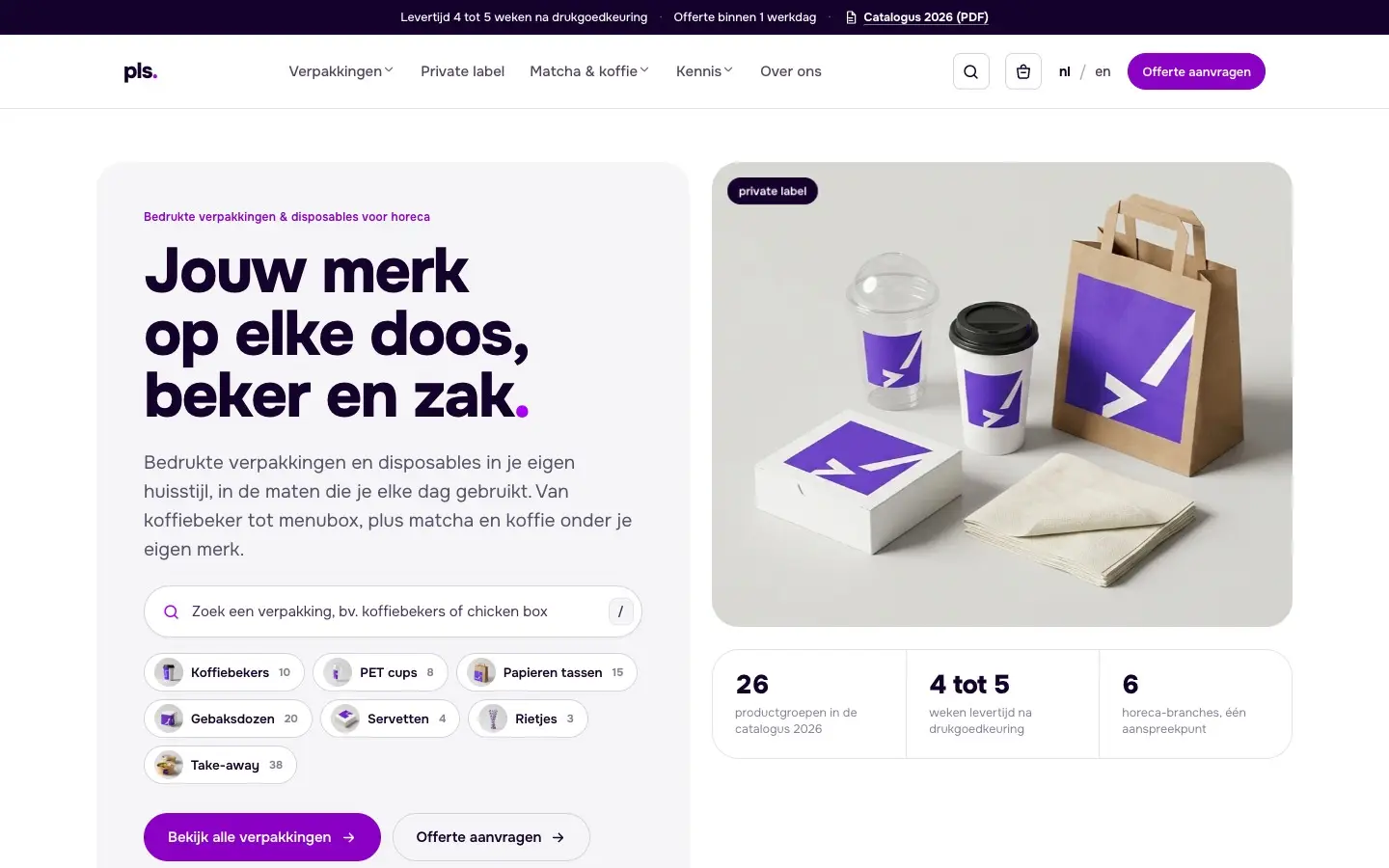
| Many pages, strict speed or custom logic | Custom code (Astro, Next.js) | Private Label Specialist, 234 pages in Dutch and English |
When you add languages to an existing site or move it to a new platform, we make a redirect map first. The URLs that already bring in visitors keep working while the new language versions build up their own rankings. If the new version is going into a Shopify store, our Shopify page covers the rest of that work.

What a multilingual website costs
What it costs depends on the number of languages and countries, the number of pages or products, the platform and how much of the site already exists. Every project gets its own proposal. After a 30-minute intro call, you'll receive a proposal with the scope, timeline and price.
Frequently asked questions
What is a multilingual website?
A multilingual website offers its content in more than one language, with a separate version for each language. Done well, each version has its own URLs, hreflang tags that connect the versions, and pages built around the words people search with in that market. A multi-country site goes one step further and also handles what changes per country, such as VAT, delivery or legal pages.
What is hreflang and why does it matter?
Hreflang is a small piece of code that tells Google which language and country each version of a page is meant for. Without it, Google may show your Dutch page to someone searching in German, or treat your language versions as duplicates of each other. We set up hreflang on every page, together with a sitemap per language, so each market sees its own version.
Should each language have its own URL?
Yes. With its own URL, each language version can be indexed on its own, and hreflang tells Google which version to show to whom. We add a sitemap per language as well. Avrupa Yöresel now has Dutch and German language versions with their own URLs, next to its original Turkish store, so a search in Dutch or German can land on a page in that language.
Is machine translation good enough for a multilingual website?
It can help with a first draft, but it rarely finds the words people in another country search with. A literal translation of your Dutch keywords often misses what German customers type. Every language gets its own keyword research, and the titles, FAQs and structured data on each page follow from that research rather than from the original language.
Can one Shopify store sell to several countries?
Yes. With Shopify Markets, one store can serve several countries, each with its own language version and settings. Midoricha, our own brand, runs one Shopify store in English, German, Dutch and French. The VAT rates follow the Shopify product category of each product, so a large catalogue usually needs a product check before a new country goes live.
How do you handle VAT when you sell to several EU countries?
On Shopify we set up VAT rates per country through the Shopify product category, so each product gets the right rate in each market. Many sellers report that VAT through OSS (the EU VAT scheme for cross-border sales). Which scheme applies to your business is something to confirm with your accountant, and we set up the store to match their advice.
Which languages do you work in?
We work and build in Dutch, English and Turkish, and we add German and French language versions for clients. Whatever the language, each version gets its own keyword research, because a literal translation often misses the words people actually search with in that country.
How much does a multilingual website cost?
It depends on the number of languages and countries, the number of pages or products, the platform and what's already in place. Adding a language to a site with a clear structure is less work than building several versions from scratch. Every project gets its own proposal. After a 30-minute intro call, you'll receive a proposal with the scope, timeline and price.